

Home Wi-Fi networks are being asked to do more than ever: support video calls, stream, run multiplayer games, and support smartphones and smart home devices, often all at once. Texas State University researcher Marcelo M. Carvalho, Ph.D., is developing an AI-based system to help home networks manage those demands faster and more efficiently.

Carvalho, an assistant professor in the Ingram School of Engineering and director of the Sustainable High-Performing Intelligent Networks (SHINe) lab, is leading the project, “Agentic TWT Scheduler for Future Home Wi-Fi,” with support from a Comcast Innovation Fund grant.
“Modern Wi-Fi access points need to make fast and smart decisions regarding who, when, how, and for how long access to the wireless channels should happen,” Carvalho said. “Making such decisions in real time is a complex task that our project is seeking to address.”
As households add more connected devices, routers must manage devices that use the network in very different ways. A gaming console may need a fast, responsive connection, while a smart TV requires a steady stream of data. Smart thermostats may connect only occasionally, while phones, tablets, and other battery-powered devices must stay connected without draining their batteries.
At the center of the research is Target Wake Time (TWT), a feature of modern Wi-Fi that allows a router to schedule when connected devices wake to communicate and when they can sleep.
Carvalho’s team is developing an “agentic TWT scheduler,” which would use AI and machine learning to analyze information from connected devices and determine when each device on the network needs resources.
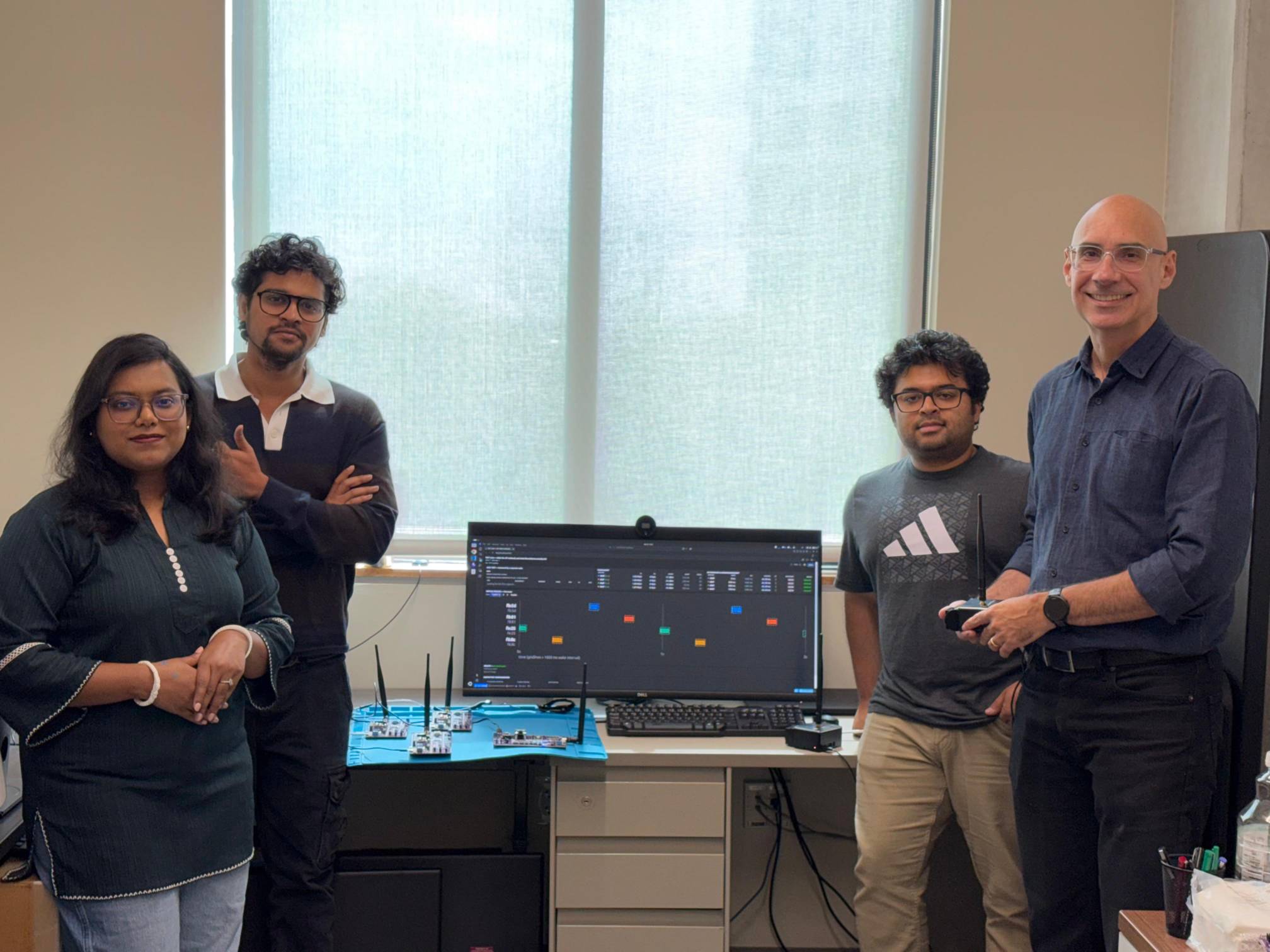
To conserve energy, the scheduler could arrange battery-powered devices to sleep when they are not in use. Smarter scheduling could also help move data more efficiently across the network and reduce delays between routers and connected devices.
“Most commercial off-the-shelf routers either do not exploit these capabilities or implement very simple and inefficient solutions,” Carvalho said. “Our project aims at designing a scheduler that leverages the power of AI and machine learning to achieve near-optimal scheduling in dynamic and heterogeneous Wi-Fi networks.”
The TWT scheduler will work within Wi-Fi standards, test different deep reinforcement learning approaches, and create an open-source codebase that other researchers can use to train and evaluate similar systems.
The project will also help create a software and hardware testbed and provide members of the SHINe lab with hands-on research experience in software development, reinforcement learning, deployment, and testing.
The team includes Ahmed Maksud, Ph.D., a postdoctoral scholar in the Ingram School of Engineering; Sandeep Sudula, an electrical engineering doctoral student; and Rishita Kundu, an electrical engineering master’s student.
Although the project focuses on home Wi-Fi, the technology could eventually improve other settings where Wi-Fi plays a key role, including manufacturing, warehousing, automotive systems, and healthcare. The work also advances the SHINe lab’s broader research into more intelligent and energy-efficient wireless networks, including future Wi-Fi and 6G systems.
“What excites me most about this project is the opportunity to design a solution for home Wi-Fi networks that makes intelligent decisions towards lowering the overall energy consumption of connected devices without compromising the quality of service,” Carvalho said.
As homes ask more of Wi-Fi, Carvalho’s goal is to help the network use less energy from the devices that depend on it.