


For starters -- ball lightning is real. The challenge is proving it. Despite interest in ball lightning for years, there isn’t much photo evidence of it. Karl Stephan, Ph.D., an electrical engineering professor at Texas State University, has been fascinated by it for nearly 20 years.
“I had read a book about it in high school,” Stephan said. “I didn’t pursue it professionally until I read about it at a lab in Austin and thought we could reproduce the experiment.”
That curiosity turned into long-term research. Stephan eventually teamed up with Richard Sonnenfeld, a researcher at New Mexico Tech University, and in 2020 the two launched a website to collect firsthand reports of ball lightning. Since then, they’ve received more than a thousand submissions. Some of those pieces of evidence have been photos from smartphones and security camera footage. Many people out there have thought that what they witnessed with their own eyes was captivating enough to capture and send to Stephan and Sonnenfeld.
“Very rarely, they’ll think fast enough to get a phone out to take a picture,” Stephan said. “Most live eyewitnesses have no photographs. The combination of a photograph and an eyewitness is, in my experience, unheard of.”
In 2023, the researchers thought they had finally struck gold.
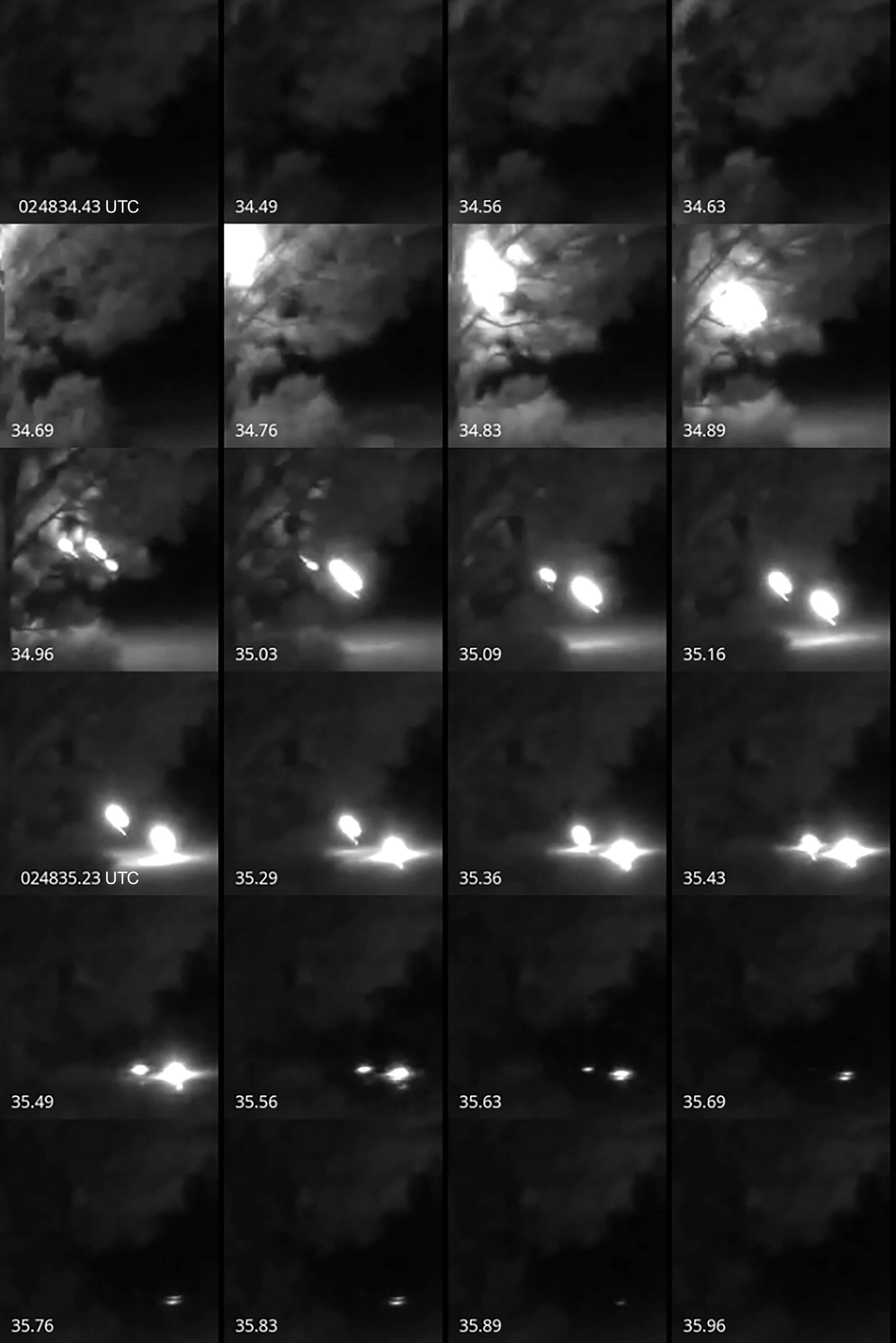
A security camera in Bozeman, Montana, captured two glowing objects flying into the frame. The orbs appeared to strike the ground, shrink and fade away, all within seconds. The footage seemed to match classic descriptions of ball lightning.
Determined to be certain, Stephan and Sonnenfeld worked closely with Janet Bertolini, who recorded the video, and analyzed it frame by frame. The researchers examined the objects’ brightness, speed, size and duration. At first, everything aligned with known characteristics of ball lightning.
But peer review brought the excitement to a halt.
Reviewers determined the glowing objects were most likely caused by a brief power outage reported moments before the video was recorded. The outage occurred on a powerline near Bertolini’s property. According to reviewers, the lights on camera were either distant lightning or an electrical arc from the powerline. Such arcs can melt tiny bits of metal, flinging them through the air where they burn brightly for several seconds.
Size also raised questions. Powerline sparks are typically no more than an inch across, yet the glowing objects appeared much larger on camera. Stephan noted that ball lightning is generally 3 to 12 inches in diameter; the objects in the video appeared to be nearly 5.5 inches.
Reviewers concluded this was likely caused by camera sensor overload. When a camera is exposed to intense light, the image can “bloom,” making the light source appear larger than it actually is. In this case, what looked like oversized glowing spheres were probably small pieces of burning metal flung from the powerline.
But not all efforts were lost.
The information gathered from this investigation actually gave researchers an insight on what to look for when they receive videos or images of supposed ball lightning. Their findings are published in the Quarterly Journal of the Royal Meteorological Society.
“We published this paper to show how easy it is to be tricked by images that look like ball lightning but aren’t,” Stephan said. “We hope to show that any kind of alleged image needs to be scrutinized very carefully.”
The search continues. Stephan and Sonnenfeld are still hoping for a clear, verifiable recording of genuine ball lightning. Anyone who believes they’ve captured the phenomenon is encouraged to submit their photos or videos through the researchers’ website.
For now, ball lightning remains real. It just hasn’t been captured on camera… yet.