

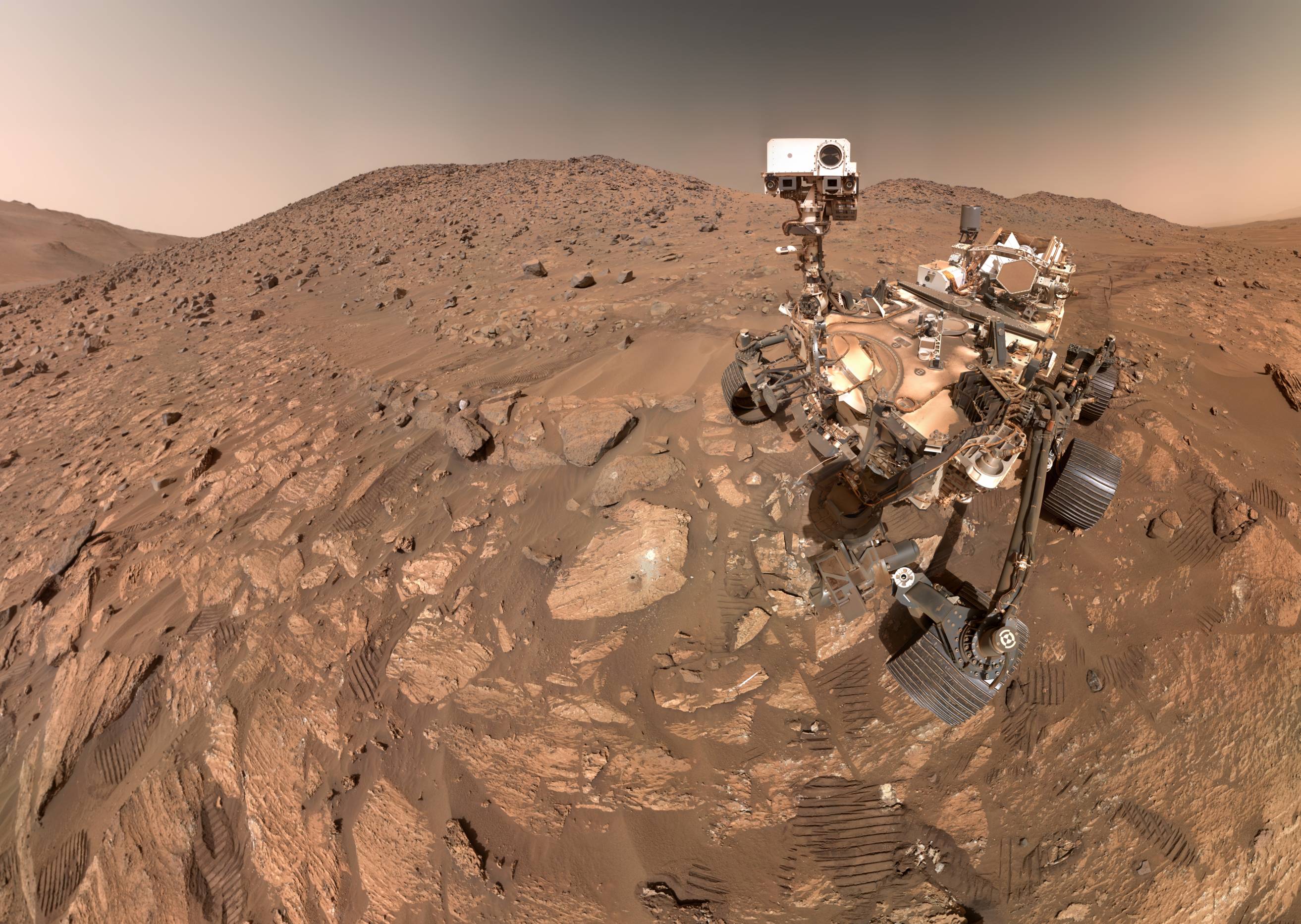
In 2021, NASA’s Perseverance rover landed on Mars to explore Jezero Crater, searching for evidence that the red planet supported liquid water on its surface and a thick carbon dioxide atmosphere in the ancient past.
New data collected and interpreted from the Perseverance rover, in part by a Texas State University affiliate that is a member of the Mars Science Laboratory (MSL) team located at NASA’s Johnson Space Center (JSC), provided evidence of the mineral olivine undergoing chemical changes similar to those that occur in aquatic environments on Earth. The findings are further evidence of an active carbon cycle on ancient Mars, an intriguing development that could be an important clue in determining whether the red planet was ever hospitable enough to support life.
Nikole Haney is a research geochemist and grant specialist with TXST’s Office of Research and Sponsored Programs’ (ORSP) Johnson Space Center Astromaterials Research Exploration and Science division (ARES) (JETSII) program. She contributed to a multinational effort headed up by Kenneth Williford, Ph.D., a research investigator with Blue Marble Space Institute of Science. The team’s findings, “Carbonated ultramafic igneous rocks in Jezero crater, Mars,” are published in the journal Science.
Haney works in the Spectroscopy and Magnetics Lab within ARES alongside lab manager Richard V. Morris. She is a collaborating scientist on SHERLOC (Scanning Habitable Environments with Raman and Luminescence for Organics and Chemicals), an instrument suite on Perseverance, where her primary work centers on analog studies and laboratory investigations.
“We use terrestrial, synthetic, and lunar samples to study Mars and the moon using a variety of analytical techniques including deep ultraviolet Raman spectrometry (like on SHERLOC),” Haney explained. “Recently, my efforts have focused on sulfates, dust and other relevant materials, with emphasis on geochemistry that supports ground-truthing rover data collected in situ on the surface of Mars to better understand surface processes and geologic formation mechanisms.”

Jezero was chosen for exploration by Perseverance because evidence suggests a lake of liquid water once filled the crater. Orbital observations showed channels and a fan-shaped delta, strong indicators of flowing water, making Jezero crater an attractive site to seek evidence of ancient water on Mars.
Perseverance sampled a wide range of rocks over the course of a 10-kilometer trek from Jezero’s western sedimentary fan to the upper crater rim that spanned 400 meters in elevation. These rocks consist of coarse-grained olivine, magnesium- and iron-carbonates, silica and phyllosilicates. The samples included some of the oldest materials exposed within Jezero.
Olivine studied by Perseverance showed extensive carbonation consistent with long-term exposure of the mineral to water and carbon dioxide. Rocks studied at higher elevations on the crater rim showed less of this aqueous alteration than those on the crater floor, a finding consistent with other evidence pointing to the presence of a persistent lake within the crater in Mars’ distant past.
“This paper shows that olivine-rich igneous rocks at Jezero crater were altered by liquid water and carbon dioxide after formation, providing in situ evidence of water-rock interaction on ancient Mars,” said Haney, who contributed scientific feedback and editorial review during the manuscript’s development. “I'm very honored to be a co-author on the paper led by Dr. Williford, and so proud to be a member of a team that produces ground-breaking research and furthers our understanding of the red planet.”