
Can scholarships fix the STEM teacher shortage? Texas State economist says partly

New research from Texas State finds scholarships can boost STEM teacher hiring, but higher pay is still needed to solve shortages in classrooms. 

Across the country, schools say they continue to struggle to recruit and retain qualified teachers. But research from Texas State University and other universities shows that the teacher workforce has actually been resilient for nearly three decades. However, the workforce is weaker when the focus is shifted to STEM teachers.  

Li Feng headshot
Li Feng, Ph.D.

Li Feng, Ph.D., Gregg Excellence Professor of Economics in the McCoy College of Business at TXST, presented her team’s findings on how the Robert Noyce Teacher Scholarship Program impacts the teacher workforce at the Brookings Institution this year. The study was funded by a National Science Foundation grant spanning 2020–2024 and involved a collaboration across four universities in Texas and Florida.

The study, “The STEM teacher workforce in high-need settings: Evidence on trends, challenges, and the role of the Noyce program,” looked at the program’s effect on the STEM workforce in high-need settings. The Noyce program provides scholarships to STEM majors who commit to teaching in high-need districts, creates partnerships between universities and school systems, and helps increase the supply and qualifications of STEM teachers.  

“We wanted to look at the impact of Robert Noyce's teacher scholarship program on how it influenced local teacher labor supply, and also down the road, looking at student outcomes,” said Feng.

The study had three objectives:

  • Explore the state of the STEM teacher workforce in high-need settings (low-income areas, staffing shortages, high-need students, and limited resources) through descriptive analysis of national survey data spanning nearly three decades.
  • Evaluate the Noyce program’s associations with STEM teacher qualifications and vacancies in the school districts located near Noyce programs.  
  • Conduct a mixed-method study with the project’s four collaborating Noyce institutions to gather and analyze data, survey alumni about their experiences, and interview stakeholders to understand how these programs prepare and support STEM teachers for high-need settings.

The study employed national survey data and conducted in-depth analysis of four universities: TXST, University of Texas at Arlington, Florida International University, and University of West Florida. The team had three major findings.  

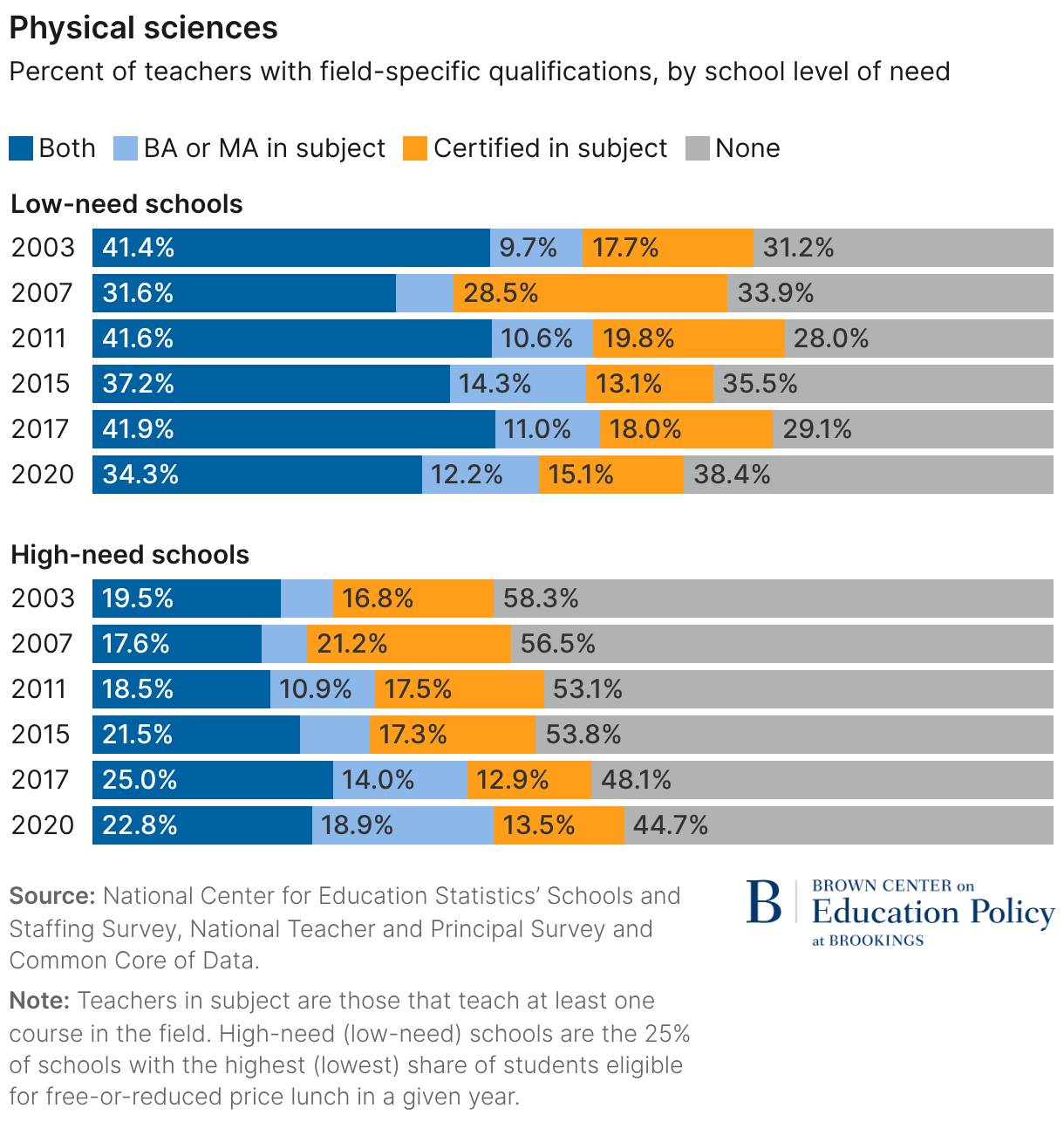
The STEM teacher workforce in high-need school systems is resilient, particularly in areas near Noyce-funded universities, where schools are up to 1.6% more likely to employ STEM teachers holding relevant degrees in their subject areas. However, critical shortages persist in specific fields: out-of-field teaching rates in high-poverty schools reach 45% in physical sciences and 58% in computer science, compared to 22% in math and 34% in biology.  

At the same time, schools reported fewer STEM teaching vacancies and less difficulty hiring qualified educators, especially in math—where the study found an approximately 8% reduction in open vacancies, and the physical and biological sciences.  
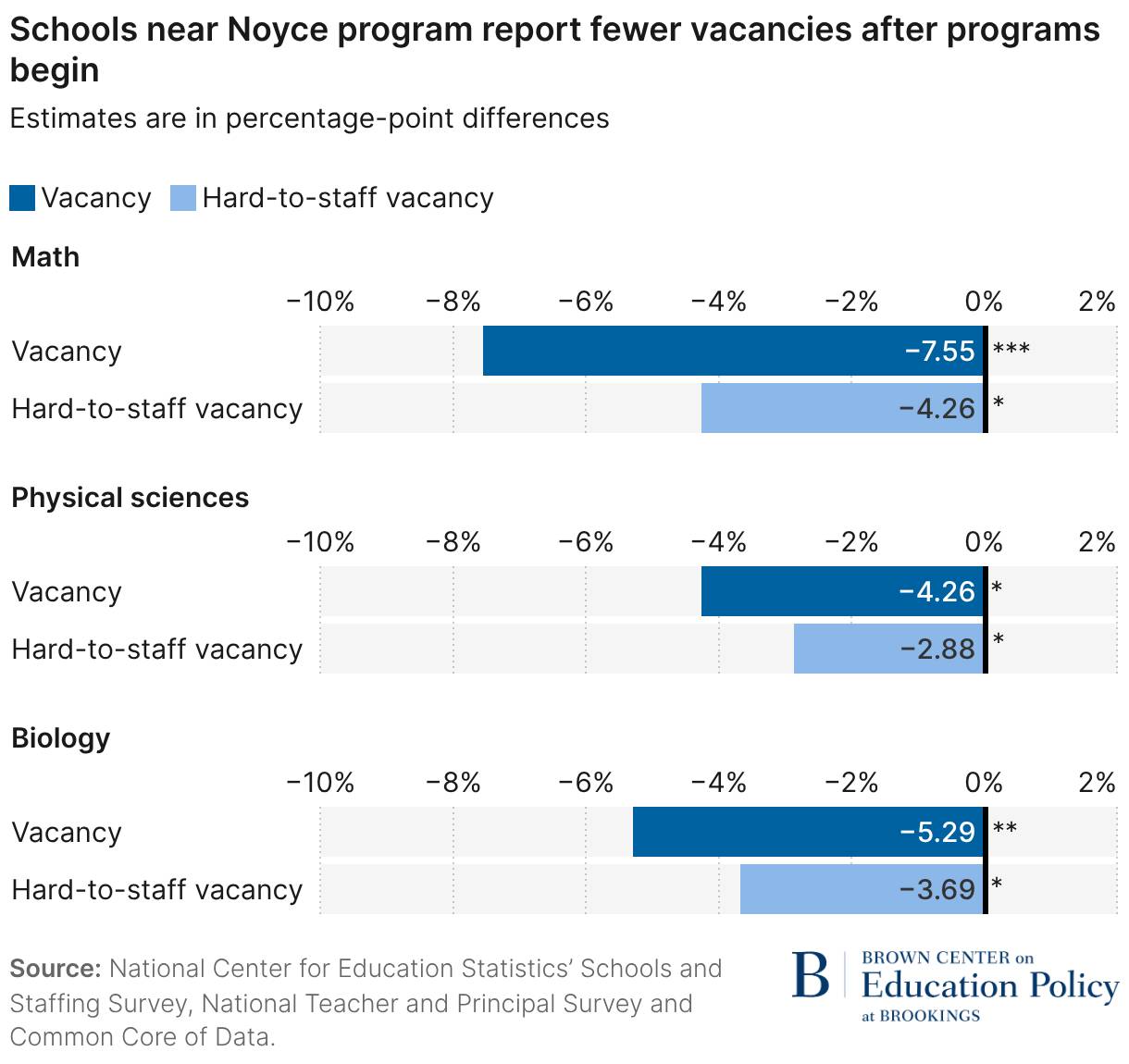
Horizontal bar chart showing percentage-point changes in teacher vacancies after Noyce programs begin. All values are negative, indicating declines. In math, vacancies decreased by 7.55 points and hard-to-staff vacancies by 4.26. In physical sciences, vacancies fell by 4.26 and hard-to-staff vacancies by 2.88. In biology, vacancies declined by 5.29 and hard-to-staff vacancies by 3.69. Math shows the largest reductions across both measures.
Teacher vacancies declined after Noyce programs began

However, the study did not find a statistically significant reduction in teacher turnover near Noyce institutions—a finding researchers note may partly reflect data limitations. The report also flagged a worrisome trend: teachers’ willingness to leave for higher pay has grown steadily over time, suggesting the workforce’s stability may be more fragile than it appears. Retaining STEM teachers remains an ongoing challenge, especially in remote rural areas such as small towns in West Texas.  

Feng said economics literature has generally stated employees should be paid more for working in challenging environments or difficult situations. The study found that STEM teachers in high-poverty schools earn 18.3% less than their counterparts in low-poverty settings—a wage penalty that effectively wipes out any premium from holding advanced degrees. She said the same logic applies to educators in rural areas.

“The teachers that have better qualifications, they get paid slightly more. But if you put that teacher in an environment in a rural, remote area, all the wage premiums that you get from getting a better degree get wiped out,” Feng said.  

A survey of 226 Noyce alumni and interviews with 19 stakeholders—including cooperating teachers, administrators, and HR personnel—consistently affirmed that Noyce graduates demonstrate strong content knowledge and are well-prepared for high-need settings. Another challenge, Feng said, is a disconnect in communication between Noyce-funded universities and school systems in their area. 

Stacked bar chart showing the share of physical science teachers by qualification type in low-need and high-need schools from 2003 to 2020. Categories include: both degree and certification, degree only, certification only, and no qualifications. Low-need schools consistently have higher shares of fully qualified teachers (about 31–42%) and lower shares with no qualifications (about 28–38%). High-need schools have fewer fully qualified teachers (about 18–25%) and higher shares with no qualifications, though this declines from about 58% in 2003 to 45% in 2020. Despite some improvement, a substantial gap between low-need and high-need schools remains over time.
Low-need schools have more qualified science teachers

“We found that some of the school district administrators, they don't even know the students that they are working with are Noyce scholars,” said Feng. “And the students are very well trained, but if you don't know about that, you may not be putting these Noyce scholars in the right classrooms.”

The research team concluded that significant financial incentives—such as higher salaries, loan forgiveness, or programs like Noyce—are needed to strengthen the STEM teacher workforce and ensure teachers are more evenly distributed across schools.

More information about the study can be found on the Brookings Institution website.  

For more information, contact:

TXST Office of Media Relations, 512-245-2180