2. Why are outbreaks often linked to fresh produce?
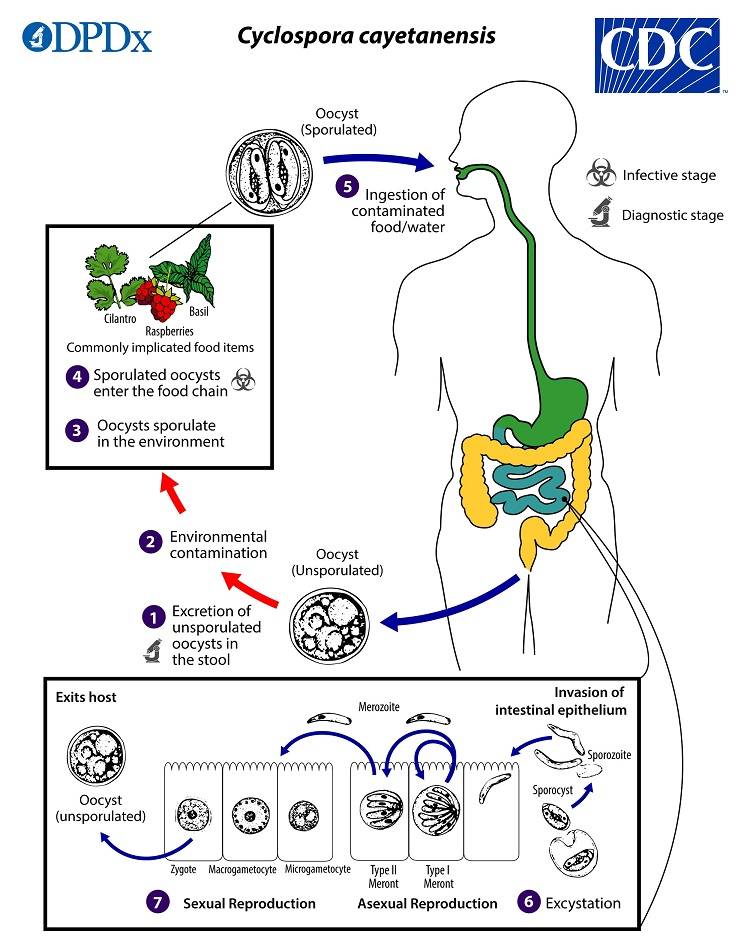
Cyclospora is unusual because people do not typically become infected directly by another person.
The parasite requires time outside the human body to mature into its infectious form. That means contamination usually occurs before food reaches your kitchen—often somewhere along the agricultural supply chain through contaminated irrigation water, produce washing, or environmental contamination.
Fresh produce such as cilantro, basil, leafy greens, raspberries, and salad mixes have all been linked to previous outbreaks because these foods are commonly eaten raw and receive little or no cooking that would destroy the parasite.
Carefully washing produce at home helps reduce risk but it cannot guarantee complete removal of the parasite, as cyclospora organisms can adhere tightly to the surface of fruits and vegetables.
3. How is this outbreak different from the large cyclospora outbreaks around 2013?
Many public health professionals remember the large Cyclospora outbreaks of 2013, when more than 600 illnesses were reported across multiple states, including Texas. Investigators ultimately linked several of those outbreaks to imported fresh cilantro from Mexico, while other illness clusters were associated with different fresh produce items, underscoring the complexity of produce-associated outbreaks. Those events highlighted major weaknesses in produce traceability and the challenges of investigating contamination within today's global food supply chain.
The current outbreak differs in several important ways.
First, investigators have identified a major outbreak cluster linked through epidemiologic and traceback investigations to shredded iceberg lettuce supplied to Taco Bell restaurants in five Midwestern states. FDA traceback investigations converged on a single supplier, resulting in a voluntary recall of iceberg lettuce products from Taylor Farms de Mexico. However, FDA subsequently determined that an initial laboratory test on a lettuce sample represented a false-positive result, illustrating one of the significant challenges of detecting Cyclospora directly in food products. Importantly, the epidemiologic evidence supporting the traceback investigation remains strong even though laboratory confirmation from the implicated lettuce has not been obtained. At the same time, CDC and FDA continue to investigate additional Cyclospora clusters nationwide that may involve different food vehicles or unrelated contamination events.
Second, today's investigators have access to far more sophisticated outbreak investigation tools than were available a decade ago. Enhanced national surveillance systems, improved epidemiologic analytics, more advanced laboratory methods, electronic traceback capabilities, and closer coordination among CDC, FDA, state health departments, and industry partners allow investigators to identify potential connections much more rapidly than was possible in 2013. Although no validated molecular typing system comparable to PulseNet exists for Cyclospora, advances in laboratory science and data integration have substantially strengthened outbreak detection and response.
Finally, produce traceability has improved considerably since 2013 through implementation of the FDA Food Safety Modernization Act (FSMA), enhanced recordkeeping requirements, and stronger collaboration across the food supply chain. These improvements have accelerated traceback investigations, yet identifying the precise source of contamination remains exceptionally difficult because Cyclospora is often present in very low numbers, is challenging to detect in foods, and many fresh produce items have relatively short shelf lives by the time illnesses are recognized. The parasite's incubation period—typically about one week but sometimes up to two weeks—also complicates patient recall of foods consumed before illness began.
One additional challenge that has become increasingly apparent since 2013 is the rapid spread of misinformation and disinformation. Public health officials today must not only investigate outbreaks but also communicate evolving scientific evidence to the public while correcting inaccurate information circulating through social media and other online platforms. Maintaining public trust through transparent, evidence-based communication has become an essential component of effective outbreak response.
4. What lessons have we learned since the 2013 outbreaks?
The biggest lesson is that food safety extends far beyond the grocery store. As the public continues to learn, human health is interwoven tightly with animal health and environmental health. This concept is known as One Health.
Preventing cyclospora infections requires attention throughout the entire food production system—from irrigation water quality and agricultural practices to harvesting, processing, transportation and retail distribution.
We've also learned that rapid communication between medical and clinical laboratories, physicians, epidemiologists and public health agencies is essential. Early diagnosis helps identify outbreaks sooner, allowing investigators to interview patients before important food exposure information is forgotten.
Perhaps most importantly, outbreaks have reinforced the value of continued investment in public health infrastructure, laboratory capacity and food surveillance systems. Diagnostic readiness is not simply about responding after people become ill. It's about building systems that detect emerging threats quickly enough to limit their impact.