

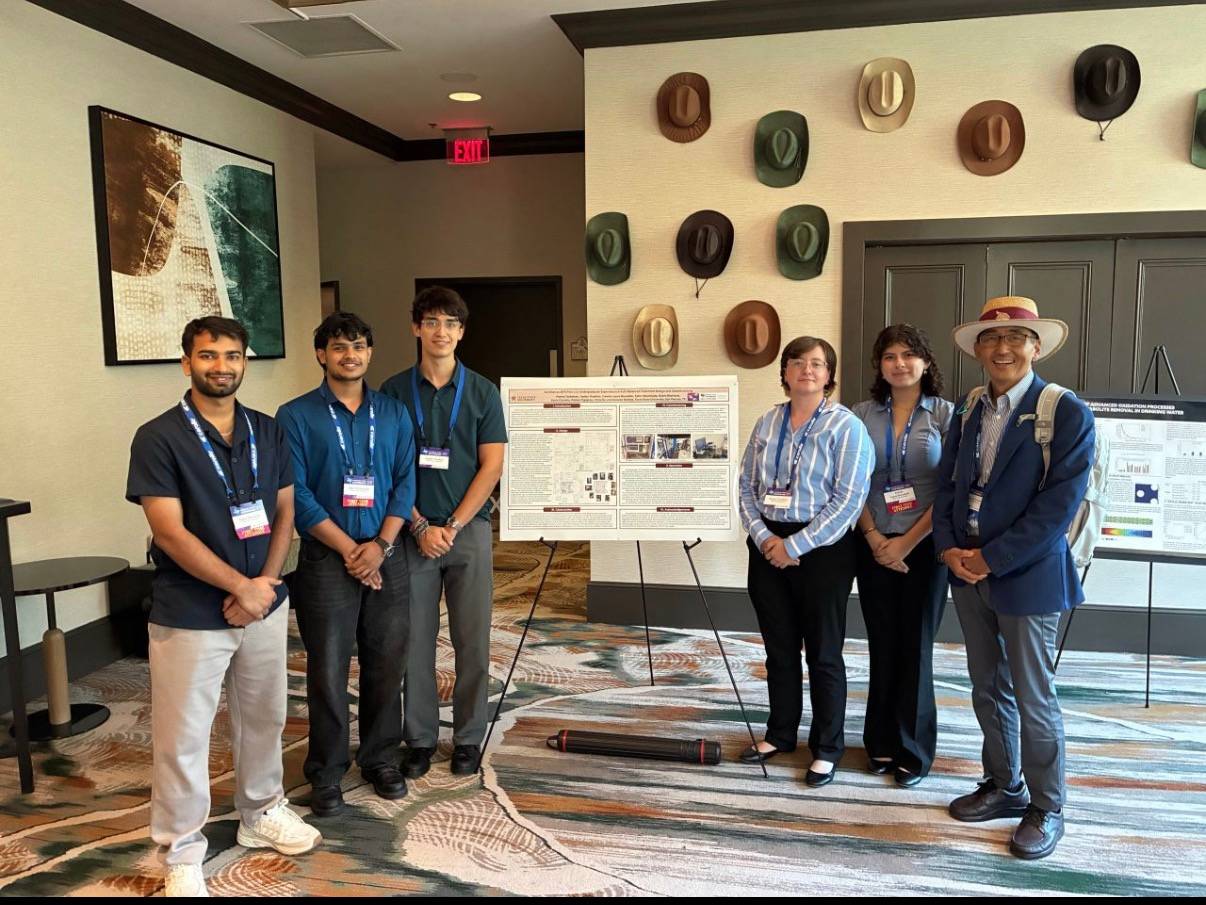
Five Texas State University students earned first place and a $1,000 award in the Student Poster Competition at the 2026 WateReuse Texas Conference in San Antonio for their work on a pilot-scale advanced water purification system at the City of San Marcos Wastewater Treatment Plant.
The students presented a poster titled “San Marcos DPR Pilot 2.0: Undergraduate Experiences in Full Advanced Treatment Design and Commissioning,” highlighting their hands-on experience helping design, construct, commission and operate the system.
The project explores direct potable reuse (DPR), a process that uses advanced treatment technologies to further purify treated municipal wastewater for potential drinking water use. The pilot system allows researchers to study how these treatment processes work together and the potential for water reuse as communities consider future water supply needs.
Under the guidance of Keisuke Ikehata, Ph.D., associate professor in the Ingram School of Engineering, the students worked on different aspects of the project, including system operation, water quality monitoring and laboratory analysis. The interdisciplinary team included Peyton Torkelson, who graduated in Spring 2026 with a degree in chemistry; Jayden Hopkins, a senior majoring in environmental engineering technology; and civil engineering students Camila Lopez-Bourdeth, Sabin Khatiwada and Nabin Bhattarai.
Torkelson was primarily responsible for weekly water sampling and laboratory analysis, including testing for bacteria and other water quality indicators. Their work helped the team evaluate how the treatment processes affected water quality throughout the system.
Torkelson said being able to observe the treatment process while analyzing samples helped them connect concepts from the classroom to the research taking place at the pilot site.
“In theory, our water is being treated,” Torkelson said. “But then to see in real time this UV oxidation is actively treating the bacteria and getting rid of it is super interesting.”
Hopkins joined the project after taking Ikehata's environmental engineering course. He worked with other students to monitor the system, check equipment and collect water quality measurements. One of the team's challenges was transitioning the system from intermittent operation to running continuously.
“We had to make sure that we were able to run it continuously without monitoring,” Hopkins said.
The project also allowed Hopkins to apply skills he had developed through his engineering coursework. Procedures he had practiced in laboratory settings became part of his work at the treatment plant.
“It was kind of nice seeing the overlap because we did a lot of the stuff that we did in lab. We would do it at the job too,” he said.

Ikehata said the students were directly involved in the technical work throughout the project, gaining experience with engineering design, equipment installation, instrumentation, troubleshooting, system operation and water quality analysis. The project also involved collaboration with the City of San Marcos and Organo Corporation, a Japanese water treatment company.
The team's poster focused on the students' experiences and contributions to the project, rather than presenting traditional research results. Ikehata said the format gave the students an opportunity to share their work with professionals in the water industry and discuss the challenges and solutions involved in developing the pilot system.
“I am very proud of what these students accomplished,” Ikehata said. “In addition to giving an excellent poster presentation, they had an invaluable opportunity to present their work directly to water reuse professionals and interact with engineers, utility representatives, researchers and other industry professionals from across Texas and beyond.”
For Torkelson, sharing the research with conference attendees was also an opportunity to discuss the importance of water reuse and address misconceptions surrounding direct potable reuse. They said research and public engagement can help communities better understand how treated wastewater can be further purified and considered as a future water resource.
“We need to be sustainable and think about how we conserve our water resources because just conserving it might not be enough for the future at this point,” they said. “We need to start reusing it.”